
Why logging it later doesn’t work
By the evening you remember the top set and forget the details that decide next session.
| What happened | What you write at 9pm |
|---|---|
| Bench: 8, 8, then 6 at 60 kg | Bench 3×8 at 60 |
| Back squat swapped for goblet squat, left knee | Squats |
| Rows went from 40 to 45 kg | Rows |
| AMRAP 12: 7 rounds plus 4 | Finisher |
Each vague line costs you next session: you load 60 for three clean eights they can’t do yet, put the sore knee back under a barbell and start rows at 40 again. Why the record matters is in our guide to personal training admin; this post is the how.
What to record, and what to skip
Exercise, sets, reps and load, plus one note at most: enough to know what goes on the bar next time, and nothing more.
- ExerciseSame name every time. “Bench” every week, not “chest press” one week and “flat press” the next, or you can’t compare.
- Sets and repsEach set on its own. 8, 8, 6 is not 3×8.
- LoadWhat was on the bar, not what you planned.
- One noteOnly if it changes next session: “left knee on deep squats”, “last rep slow”.
Skip:
- Warm-up sets. If the ramp matters, one line covers it: “warm-up 5 at 40, 5 at 50”.
- Rest times, unless rest is the point of the block.
- The cues you gave. You’ll give them again.
- “Felt good.” That’s noise, not a note.
How to log between sets without breaking the session
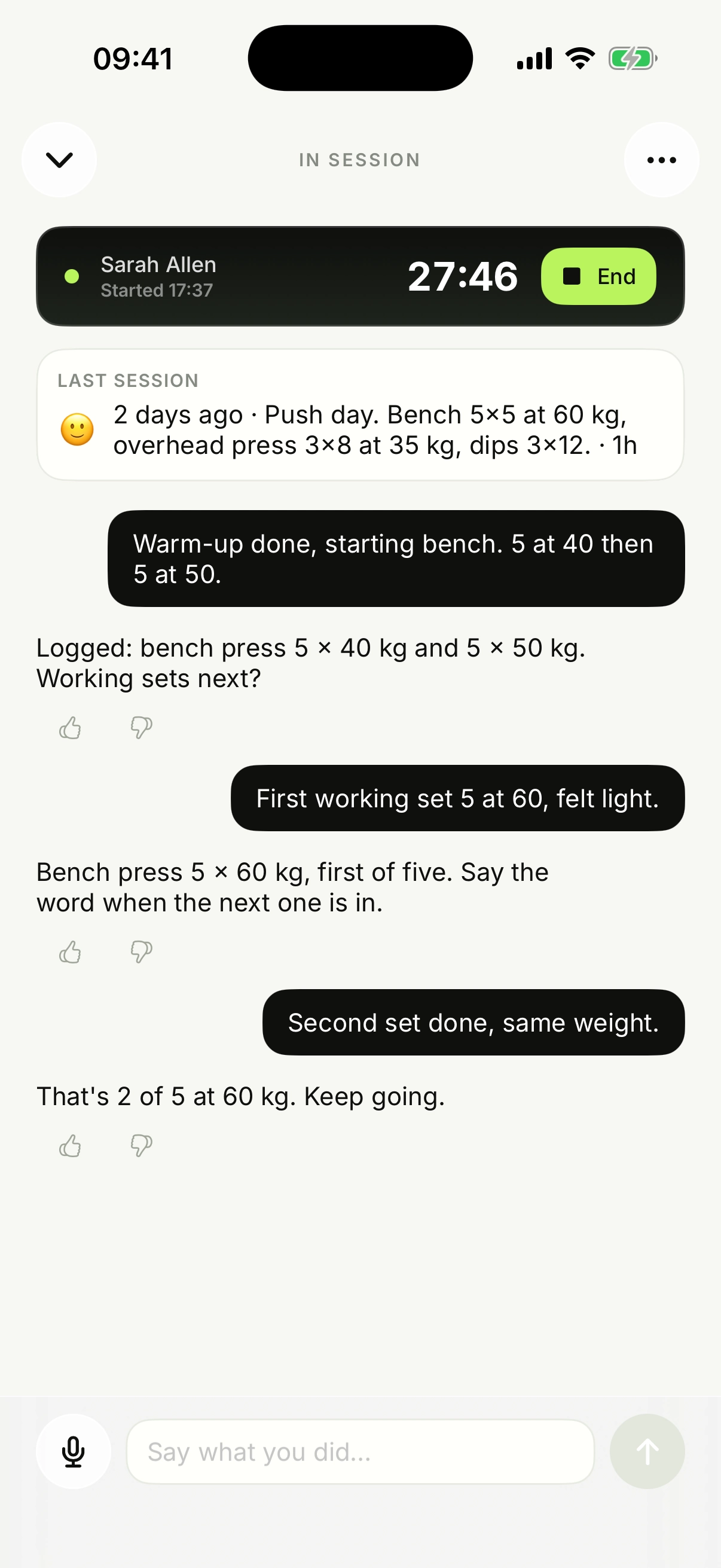
Logging fits inside the rest between sets, so the session never stops for your notes.
- 1Weight down, log, then coach. Log while they breathe, never while they lift.
- 2One line, same order every time: exercise, load, reps. “Bench, 60 for 8.”
- 3Say it out loud, with your phone’s dictation on. Your client hears the number too, and that’s feedback.
- 4Same again? “Same.” One rep fewer? “Same, 7.”
- 5Missed one? Log it at the next rest, not at the end.
Typing instead? Fix a shorthand and never change it, so the log still reads in six months:
| You type | It means |
|---|---|
| bp 60x8 | Bench press, 60 kg, 8 reps |
| s | Same as the last set |
| s 7 | Same load, 7 reps |
| pu bw 12 | Pull-ups, bodyweight, 12 reps |
A set logged before the next one is a record. A set logged at 9pm is a guess.
How to log supersets, circuits, AMRAPs and EMOMs
Name the format and loads once, then log only what changes: each superset pair, a missed minute, the final score. Never every rep.
1Supersets
- Looks like
- Two exercises back to back, rest after the pair.
- Do this
- Log both after the pair, in one line. Say “superset” once so you know they were paired.
Superset: row 40 for 10, press-ups 12.
2Circuits
- Looks like
- Three to five stations, three rounds, little rest.
- Do this
- Log the circuit once before round one. After that, only what changed.
Circuit, 3 rounds: swings 24 for 15, goblet squat 20 for 10, row 250 m.
3AMRAPs
- Looks like
- 12 minutes, as many rounds as possible.
- Do this
- Log the movements and loads at the start, the score at the end. Keep the round count as a tally on the whiteboard, not in your head.
AMRAP 12 done, 7 rounds plus 4.
4EMOMs
- Looks like
- A set on every minute for 10 minutes.
- Do this
- Log the work once. Then only the minutes they missed or scaled.
EMOM 10, 5 deadlifts at 80, missed minute 9.
What to do with the log afterwards
The log earns its keep twice: it sets next session’s target, and it shows your client they’re getting stronger.
- 1At the end, write one sentence: the main lift and anything that changes next session. “Push day: bench 8, 8, 6 at 60, knee fine on goblets.”
- 2Before the next session, read that sentence. That’s your “what did we do last time”, answered in one glance instead of a scroll through WhatsApp.
- 3Pick one target from it. Last time 8, 8, 6 at 60? Today, all three at 8.
- 4Before they leave, tell them one number that moved: “8 at 60. A month ago that was 6.”